
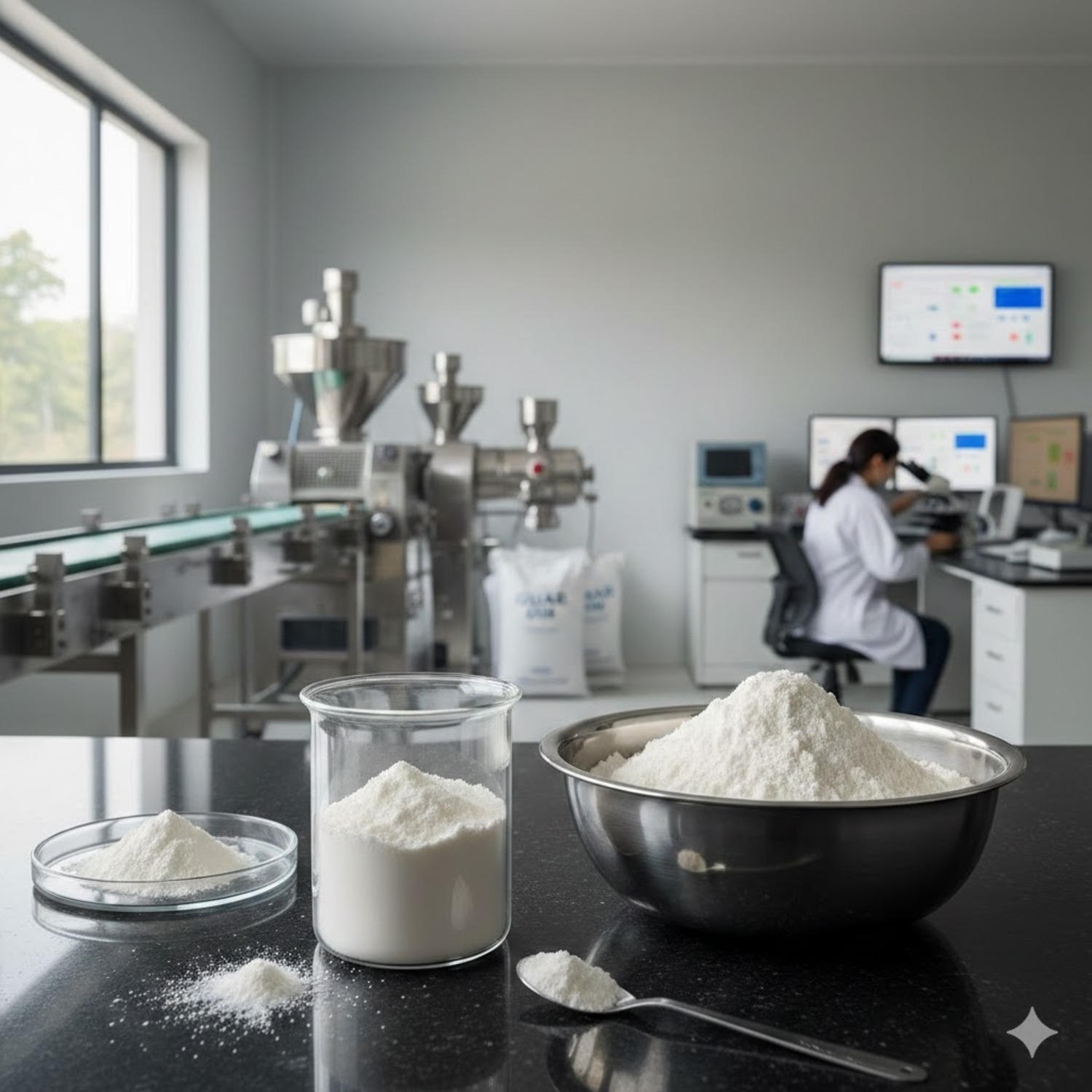
In industries ranging from food processing to oilfield drilling, guar gum is the unsung hero of viscosity. However, procurement managers often face a frustrating reality: a 5,000 cps batch from one month might perform differently from a 5,000 cps batch from the next.
This lack of uniformity can lead to “fish eyes” in food textures or unstable fluids in industrial applications. At Meskay & Femtee Trading Company (MFTC), we believe that understanding the “why” behind guar gum batch variation is the first step toward better supply chain management.
Here is the deep-dive science and the “Competitor Gaps” most suppliers won’t tell you.
1. The Agricultural Root: Seasonal and Environmental Shifts
Guar gum is a natural agricultural product derived from the Cyamopsis tetragonoloba plant. Unlike synthetic polymers, its properties are dictated by the soil and the sky.
- The Rainfall Factor: Guar is a drought-tolerant crop, but it requires precise rainfall at the maturation stage. Research shows that excessive moisture during the final seed maturation leads to lower-quality beans with reduced galactomannan (the active gum) content.
- The Seasonal Gap: The sowing season impact. Studies indicate that summer-sown guar consistently yields higher viscosity and greater galactomannan proportions compared to Kharif or Rabi sowings. If your supplier mixes harvests from different seasons, your batch performance will fluctuate.
2. The Milling Paradox: Particle Size vs. Hydration
In guar gum production, the milling process is where the “magic” happens or where it fails.
- The Mesh Size Influence: The finer the mesh (e.g., 200 mesh vs. 80 mesh), the faster the gum hydrates. However, very fine grinding generates high heat in the mill.
- The Heat Trap: If the mill temperature isn’t strictly controlled, it can “degrade” the molecular chains of the polymer. This results in a powder that looks correct and passes a mesh test, but lacks the “long-term” viscosity stability required for industrial use.
3. The “Splits” Selection
The quality of the final powder is only as good as the guar splits (the endosperm) used.
- Hull & Germ Contamination: The seed consists of the hull (fiber), the germ (protein), and the endosperm (gum). If the de-husking and polishing stage is inefficient, tiny traces of protein (germ) remain in the splits.
- The Result: High protein content in a guar gum batch acts as an impurity that interferes with hydrogen bonding. This is why some batches might feel “stringy” or “sticky” rather than providing a smooth, clean thickening effect.
4. In-Process Hydration and Extrusion
During production, the splits are hydrated with water before being ground into powder.
- Water Quality: Most manufacturers overlook the pH and mineral content of the water used during pre-hydration. Using “hard water” with high salt content can reduce the hydration rate of the final product by competing for water-binding sites.
- Uniformity: If the splits are not hydrated uniformly in the double-cone mixer, you end up with a “heterogeneous batch” where some particles are over-processed, and others are under-hydrated.
How MFTC Ensures Batch Consistency
At MFTC, we bridge these gaps through a “Source-to-Shelf” protocol:
- Controlled Sourcing: We prioritize seeds from specific stable-climate regions to minimize M: G ratio fluctuations.
- Advanced Polishing: Our refined splits undergo multiple magnetic and air-separation cycles to ensure <1% germ contamination.
- Viscosity Mapping: We don’t just test “peak viscosity”; we test the hydration curve to ensure the gum performs predictably in your specific mixing equipment.
Struggling with inconsistent guar gum performance?
Don’t let batch variation disrupt your production line.
Request a Certificate of Analysis (CoA) & a Sample from MFTC and experience the difference in precision-milled quality.
Quick Reference: Batch Comparison Table
| Feature | High-Quality Batch | Low-Consistency Batch |
| Galactomannan | >82% | <75% |
| Protein Content | <4% | >6% (Indicates germ contamination) |
| Moisture | 8% – 10% | >13% (Risk of clumping) |
| Color | Off-white / Cream | Yellowish (Indicates heat damage) |
| Mesh Uniformity | 99% through the specified mesh | Significant “overs” or “under.” |
FAQs
1. What is guar gum?
Guar gum is a natural polysaccharide; in simple words, a complex carbohydrate extracted from guar beans. It is widely used as a thickening, binding, and stabilizing agent in foods, cosmetics, pharmaceuticals, and industrial products.
2. How to dissolve guar gum in water?
To dissolve guar gum in water without making any clumps, sprinkle it slowly into water (cold or hot) while vigorously stirring it, or you can use a blender for high shear, or pre-mix the powder with sugar/oil before adding to liquid.
3. How to make guar gum?
The gum is commercially extracted from seeds essentially by a mechanical process of roasting, differential attrition, sieving and polishing.
4. How to make guar gum powder?
Through the heating, grinding, and polishing process, the husk is separated from the endosperm halves and the refined guar split is obtained. Through the further grinding process, the refined guar split is then treated and converted into powder.
5. How to use guar gum in ice cream?
It is quite incredible how little of this ingredient you need to use. When you’re whipping up your next batch of ice cream, simply add between 1/4 to 1/2 teaspoon of guar gum to your base for each litre of ice cream.
6. What is guar gum used for?
Guar Gum has industrial, pharmaceutical, food and beverage, cosmetic, and health and nutrition-based applications.
Leave a Reply