
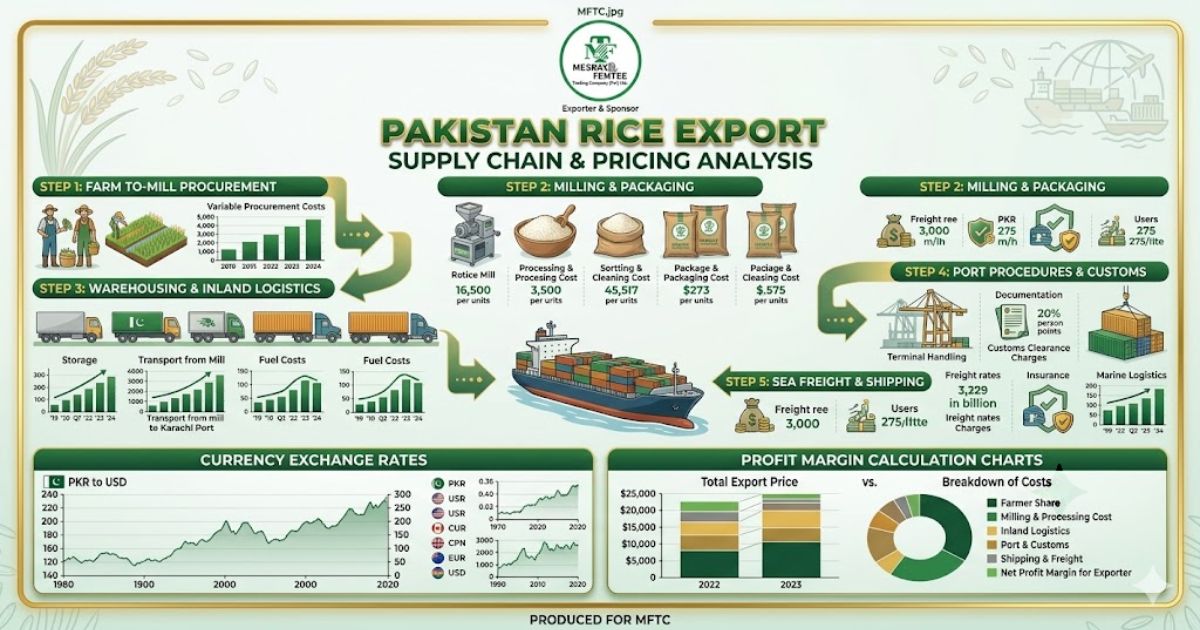
Pakistan ranks among the world’s elite suppliers of high-grade Basmati and non-Basmati varieties. Yet, calculating profitable export prices is a complex challenge that depends on volatile farm-gate costs and global shipping rates.
For rice exporters in Pakistan, surviving in a highly competitive, low-margin global market requires total cost control. Top trading firms secure their profit margins by optimising every step of the supply chain from raw paddy procurement and automated milling to port logistics and international customs clearance.
Major Factors That Affect Rice Export Prices
Rice export prices are dependent on a mix of agricultural, economic, and political factors. Here are the major factors that determine the pricing of export rice:
1. Domestic Production Costs
The final export price must cover the expenses incurred before the rice even leaves the origin country.
- Milling and Processing: Energy prices affect the cost of running industrial mills, colour sorters, and polishing machinery.
- Packaging: High-quality, moisture-resistant bags add to the export cost.
3. International Demand Dynamics
Global market pressure, dictated by major buyers, heavily influences pricing trends.
- Bulk Importing Changes: High demand from major importing regions (such as West Africa, China, and the Middle East), with the exporters commanding premium prices.
- Alternative Crop Prices: If grains like wheat or corn become too expensive, global demand shifts toward rice. You can monitor these shifting baseline demands through official USDA Grain Market Reports.
4. Currency Fluctuations and Macroeconomics
Because international rice trading is conducted in global currencies, foreign exchange rates play a massive role.
- Local Currency Fluctuations: When an exporting country’s currency decreases against the US Dollar, its rice becomes lesser for foreign buyers.
- Inflation: Domestic inflation increases the cost of labour and inland transport, forcing exporters to raise their final quotes.
5. Logistics and Freight Costs
The cost of moving bulk cargo from local fields to international ports dictates the final price format (FOB or CFR).
- Inland Trucking: Fuel costs increase the price of transporting rice from rural mills to seaport terminals.
- Ocean Freight Rates: Volatile global shipping container rates and shipping route disruptions add a significant variable premium to the final cost.
How Profit Margins Are Calculated in Rice Export
Calculating profit margins is essential for any rice export business. It helps Pakistani exporters balance their processing costs against changing international market prices. It includes
- Subtract total costs from revenue.
- Calculate gross profit margin first.
- Factor in variable shipping costs.
- Include processing and milling fees.
- Account for currency exchange shifts.
- Divide net profit by sales.
By tracking every expense from farm to port, businesses can safely navigate volatile global markets. This financial clarity is what separates sustainable export growth from sudden losses.
Currency Exchange Rates and Export Profit Margins
Currency exchange rates act as a major swing factor for Pakistani rice export profit margins. Because international rice trade is settled in US Dollars (USD), shifts in the value of the Pakistani Rupee (PKR) directly alter financial returns.
Here is how currency movements impact export margins:
1. Local Currency Depreciation
When the Rupee devalues against the US Dollar, it temporarily boosts exporter profits. Exporters convert their USD revenue into more local currency, allowing them to lower global quotes and win contracts.
2. Local Currency Appreciation
A stronger Rupee directly hurts export margins and reduces market competitiveness. When the Rupee gains value, USD revenues yield fewer total Rupees, squeezing net profits against high domestic costs.
3. The Inflation Catch-Up
Gains from a weaker Rupee are short-lived due to rapid domestic inflation. Devaluation drives up the local cost of imported fuel, fertiliser, and machinery, quickly swallowing the initial profit cushion.
Future Trends in Pakistan’s Rice Export Market
Rice export cost in Pakistan is shifting rapidly to counter intense regional competition and climate challenges.
- Adopting climate-resilient hybrid seeds.
- Upgrading to energy-efficient mills.
- Expanding direct trade with China.
- Securing new African market agreements.
- Enforcing stricter global quality standards.
Pakistan’s rice export sector is modernising rapidly to secure growth. Exporters adopt sustainable farming technology. Firms expand into new trade hubs. These actions counter global economic pressures.
Why Choosing the Right Export Partner Matters
Choosing the right export partner ensures stable pricing and smooth international logistics. A reliable supplier like Meskay & Femtee Trading Company (MFTC), manages volatile freight rates and currency shifts while protecting vital import margins.
- Ensures stable, reliable pricing.
- Mitigates volatile freight risks.
- Protects vital import margins.
- Delivers premium cargo on time.
Conclusion
Navigating the Pakistani rice export market requires strict cost control. Exporters who manage freight costs and currency shifts effectively secure the best long-term profits.
Explore Profitable Rice Export Opportunities
FAQs
1. How is rice export pricing calculated in Pakistan?
A: Exporters add the raw paddy cost to processing expenses. They include milling, grading, and packaging. They add local transport, customs, and ocean freight. A final target markup is added for the total quote.
2. What affects rice export profit margins?
A: Margins depend on currency exchange rates and global demand. International freight rates and domestic energy costs also change margins. Weather shocks affect crop yields and fluctuate profits.
3. What are the export costs for Pakistani rice?
A: The main cost is buying raw paddy from local farmers. Other costs include industrial milling and sorting. Exporters also pay for quality certifications, packaging, and port logistics.
4. Why do Basmati rice prices fluctuate internationally?
A: Basmati is a climate-sensitive crop grown in specific regions. Weather changes quickly alter the supply and spike prices. Currency shifts in Pakistan also make the international basmati rice export price fluctuate.
Leave a Reply