
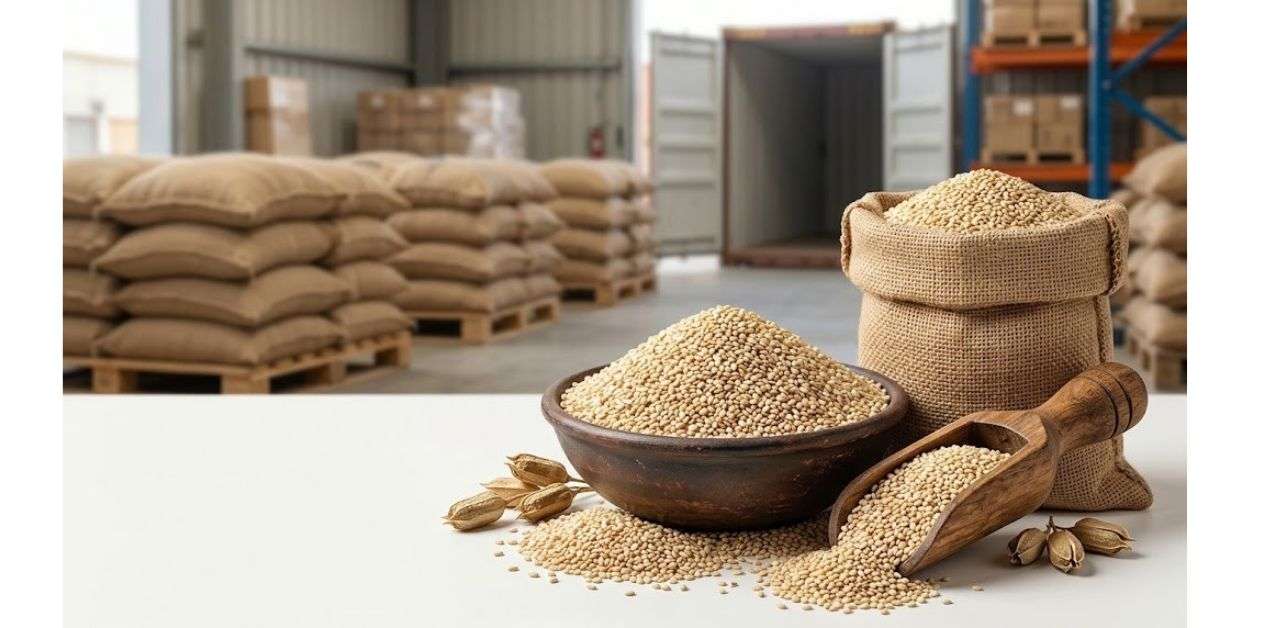
The first and logical question that comes to mind for international buyers and traders buying sesame from Pakistan is: What is the price of sesame that is available in Pakistan per 40kg? The truthful answer is that it fluctuates, sometimes, every week, sesame is a traded agricultural crop, not a fixed price product. This guide describes the true factors that contribute to the rate, so you can read a quotation and have a good grasp of the price you are paying for.
Why There’s No Single “Fixed” Price
Sesame is a commodity, and similar to other commodities, its price is determined by supply and demand, and not by a fixed rate card. This is why there are different figures at different times and in different locations.
In general, the price of sesame seeds in Pakistan during 2026 has been approximately between Rs. 12,000 and Rs. 16,000 per 40kg; the export grade white sesame is normally at its highest price. But any specific number is a snapshot, not a fixed rate. For a serious buyer, the more useful knowledge is what moves that number, which is what the rest of this guide covers.
What Drives the Sesame Seed Price in Pakistan
Several factors combine to set the sesame rate in Pakistan at any given moment. The main ones are summarised below.
| Factor | Effect on Price |
|---|---|
| Harvest & supply | Prices fall during peak harvest, rise in the off season |
| Quality & grade | Cleaner, export grade seed commands a higher rate |
| Export demand | Strong international demand pushes prices up |
| Currency (PKR) | A weaker rupee often raises local export crop prices |
| Region | Transport and access cause city to city differences |
Each of these is worth understanding on its own, because together they explain almost every price movement a buyer will encounter.
The Seasonal Effect: Why Timing Matters
Harvest timing is one of the biggest influences on the sesame price in Pakistan. Sesame in Pakistan is mainly harvested in October and November, and this is when supply is at its highest.
The pattern is consistent: during peak harvest, abundant supply tends to push prices down, while in the off season, scarcity drives them up. For buyers, this means timing a purchase around the harvest window can make a real difference to the rate per 40 kg. A knowledgeable supplier can advise on where the season sits and how it is likely to affect near term pricing.
How Quality Affects the Rate per 40 Kg
Not all sesame is priced the same, because quality varies significantly, and quality is one of the clearest drivers of price. Export grade sesame, clean, well sorted, and low in moisture and impurities, consistently commands a higher rate than lower grades.
Several quality factors feed into the price:
- Purity and cleaning — seed free from dust, stones, and foreign matter
- Colour and uniformity — consistent, well graded seed is worth more
- Moisture content — properly dried seed stores better and grades higher
- Sorting and grading — machine sorted, uniform seed earns a premium
- Free Fatty Acid (FFA)
This is why two quotations for sesame seeds in Pakistan can differ noticeably: they may be for genuinely different grades. When comparing prices, buyers should always confirm they are comparing the same quality.
Why Export Demand Moves the Price
Pakistan is a major force in the global sesame trade, and international demand has a direct effect on the domestic rate. Pakistan is the world’s fourth largest exporter of sesame seeds, and when overseas demand is strong, particularly from large buyers, it pulls the local price upward.
The value of the rupee plays into this as well. Because sesame is an export crop, a weaker rupee can make Pakistani sesame more attractive to foreign buyers while raising the local price. For an international buyer, this connection between global demand, currency, and local rate is central to understanding why the sesame seed price shifts the way it does.
Why Prices Differ Between Karachi and Other Markets
Buyers often notice that sesame seed prices in Karachi differ from rates quoted elsewhere in the country, and there is a straightforward reason. Karachi is Pakistan’s main port and sesame processing and export hub, so it sits at the centre of the export trade.
Prices vary by region because of transport costs, proximity to farms, and access to processing and export facilities. Growing regions in Punjab and Sindh may show different farm gate rates, while Karachi reflects export oriented, processed, export grade pricing. For an international buyer, the Karachi based, export grade rate is usually the most relevant reference point, since that is the seed prepared and documented for export.
How to Get an Accurate Sesame Price Quote
Because the price moves daily and depends on grade, the only reliable way to know your true cost is to request a current quotation for your specific requirement. A general figure from a price tracking website is a useful reference, but it is not a quote you can trade on.
For an accurate price, a buyer should specify:
- The grade and specification required (purity, colour, moisture)
- The quantity and packaging
- The destination and Incoterms
- The delivery timeline
With those details, a supplier can provide a firm, current price. As an established sesame seed supplier in Pakistan and one of the country’s leading exporters, MFTC supplies export grade sesame to international buyers with transparent, current pricing and full documentation. To receive a quotation for your requirement, contact the MFTC team.
FAQs
1. What is the current sesame seed price in Pakistan per 40 kg?
A: As of 2026, wholesale rates generally range from around Rs. 12,000 to Rs. 16,000 per 40 kg, depending on quality, grade, region, and season. Because it moves with the market, buyers should request a current quote for an accurate figure.
2. What factors affect sesame seed prices in Pakistan?
A: The main drivers are harvest supply, seed quality and grade, export demand, the value of the rupee, and regional transport and access differences.
3. Why does the sesame rate change during the harvest season?
A: During peak harvest, around October and November, supply is high, which tends to lower prices. In the off season, reduced supply pushes prices up.
4. Does sesame quality affect its price per 40 kg?
A: Yes, significantly. Clean, well sorted, low moisture, export grade sesame commands a higher rate than lower grades, so price comparisons should always be for the same quality.
5. How do export demand and international markets affect sesame prices in Pakistan?
A: As the world’s fourth largest exporter, Pakistan’s local sesame price is sensitive to international demand. Strong overseas demand and a weaker rupee both tend to raise the price.
6. Why can sesame prices differ between Karachi and other markets?
A: Karachi is the main export hub, so its rates reflect processed, export grade pricing. Growing regions may show different farm gate prices due to transport and access.
7. How can buyers get a sesame seed price quote from a Pakistani supplier?
A: By specifying grade, quantity, destination, and timeline, and requesting a current quotation from an exporter.