
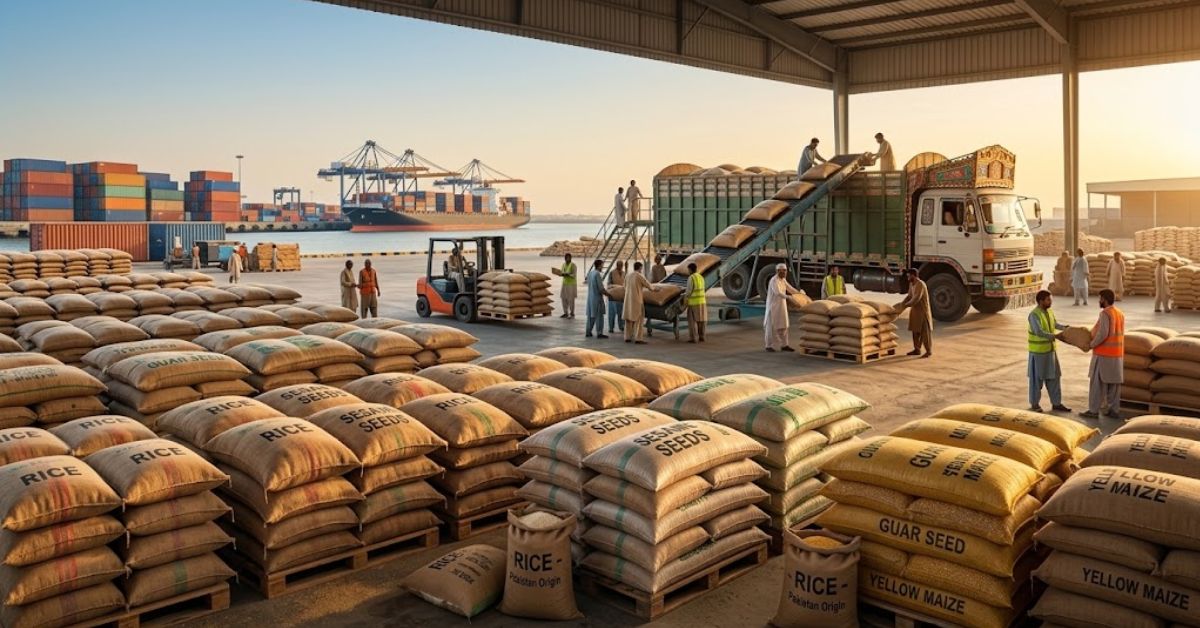
Crops don’t care about your shipping schedule. Rice comes in around autumn, maize twice a year, sesame and guar in their own windows, and yet buyers need supply all year round. Bridging that gap is the quiet, unglamorous work behind rice export. Here’s how it’s actually done. And it starts with respecting the calendar.
Why Seasons Rule the Export Business
Here’s the tension nobody really talks about: crops arrive in bursts, but demand is steady all year.
Harvest floods the market for a few weeks. Then, for months, nothing new comes out of the field. If an exporter hasn’t planned for that, buyers feel it, and they feel it in the worst ways, like late shipments, patchy quality, or prices that swing without warning. Seasonal planning is what stops that from happening. Which means the first thing any exporter needs is a solid grasp of the calendar.
When Each Crop Is Harvested in Pakistan
Pakistan runs on two main crop seasons. Kharif, the monsoon season, is sown from around April to July and harvested between October and December. Rabi, the winter season, is sown from October to December and harvested in April and May. Rice, maize, sesame, and guar are all Kharif crops, which is why they cluster the way they do.
According to the official crop-cut calendar published by the Punjab Crop Reporting Service, here’s when each one comes in:
Maize is the useful exception. Alongside the autumn harvest, there’s the spring or baharia crop, sown around February and March and harvested in June and July, mostly in Punjab. So maize gives you two bites per year rather than one.
Notice something, though? Three of the four lands within about six weeks of each other. That’s both a blessing and a logistical headache. So what happens during the other eight months of the year?
The Off-Season Problem, and How It’s Solved
Simple answer: storage and planning. The less simple answer: storage and planning done properly.
Buy at harvest, when quality and availability are at their peak. Store it in controlled conditions because moisture and pests will undo a good crop faster than anything. Manage inventory against forecast demand rather than guesswork. Then process and ship on a rolling schedule through the year.
Get any of that wrong, and the grain degrades, or you simply run out. Get it right, and the buyer never notices the season at all. That’s the theory, anyway. Here’s how we actually run it.
How We Plan for Seasonal Demand
At MFTC, seasonal planning runs across the whole chain because we own the whole chain.
We procure directly from farming regions across Pakistan at harvest. We mill and process in our own facilities, then warehouse the product, including large-scale storage at Port Qasim. From there, we forecast buyer demand and ship on schedule to over 150 destinations across every continent, moving roughly one million tons of product a year.
That vertical integration is the point. When you control procurement, milling, storage, and shipping yourself, year-round supply becomes something you can actually promise rather than something you hope works out. You can see the full product range here. There’s one more advantage in all this, and it’s a structural one.
Why a Diversified Portfolio Smooths the Curve
Here’s the quiet benefit of running several product lines: the crops don’t all fail, or all peak, at the same time.
A weak rice year doesn’t stall the business. Maize has two harvests, which offset a single-season crop. Guar comes in late, in November and December, well after sesame has already been and gone in October. Each follows its own rhythm.
For a buyer, that means a supplier who stays steady even when one crop has a bad season. Diversification isn’t just a longer product list. It’s risk management, and it’s the reason a multi-commodity exporter can keep its commitments when a single-crop trader can’t. All of which comes back to one thing for you.
What This Means for Buyers
In practical terms, here’s what seasonal planning buys you:
- Supply you can schedule around, rather than gamble on
- Consistent quality whether you order in March or October
- Fewer surprises on lead times and availability
- One partner across rice, sesame, guar, and maize
Honestly, the best compliment an exporter can get is that a buyer never had to think about harvest seasons at all. That’s the whole goal.
Tell us your requirement and your timeline, and we’ll build the schedule around it.
Harvests have seasons. Your supply shouldn’t. Meskay & Femtee Trading Company plans across rice, sesame, guar, and maize so global buyers get consistent, quality-controlled supply, whatever the season.
FAQs
1. Why is seasonal planning important in agricultural exports?
A: Because crops arrive in short bursts while demand runs all year. Without planning, exporters face shortages between harvests, quality loss in storage, and unstable prices. Good planning keeps supply and quality steady for buyers regardless of the season.
2. How do exporters ensure year-round supply?
A: By procuring at harvest when quality peaks, storing in controlled conditions, forecasting demand against inventory, and shipping on a rolling schedule. Controlling the whole chain, from procurement through milling and warehousing to shipping, is what makes it work.
3. When are rice, sesame, guar, and maize harvested in Pakistan?
A: In Punjab, rice is harvested from mid-September to late November, sesame through October, guar from mid-November to mid-December, and autumn maize in November. Maize also has a spring crop harvested around June and July. All are Kharif crops.
4. How does inventory planning support export businesses?
A: It matches available supply to forecast buyer demand, protects grain quality through proper storage, and stabilises lead times. Without it, exporters either run short between harvests or hold stock that degrades before it ships.