
If you are a procurement manager or a production lead, the pressure to cut raw material costs is constant. When you see a supplier offering guar gum at a significantly lower price per kilogram, it feels like an easy win. You save money upfront, and on paper, the math looks great.
But does it?
In manufacturing, the “price per kilo” is rarely the “cost in use.” We have analyzed the production cycles of major industries from food processing to oil drilling and found a recurring pattern: cheaper guar gum often acts as a silent budget killer.
This article breaks down the hidden expenses of low-quality gum and why upgrading your specs might actually lower your total production cost.
The “Price per Kilo” Trap
Let’s say you switch to a cheaper guar gum powder that saves you 15% on the invoice. However, this cheaper variant likely has lower viscosity or higher insoluble residue.
If your standard recipe calls for 10kg of gum to achieve a specific thickness, a lower-quality gum might require 12kg or 13kg to get the same result. You have immediately wiped out your 15% savings, and you are now handling more material, storing more stock, and dealing with more waste.
The Reality Check: You don’t pay for the powder; you pay for the effect (viscosity, binding, or stabilisation). If you need more powder to get the effect, you haven’t saved a dime.
3 Hidden Costs of Low-Quality Guar Gum
Most competitors talk about the benefits of guar gum, but few discuss the financial risks of using the wrong grade. Here is where the money usually leaks:
1. The “Fish Eye” Effect and Machine Downtime
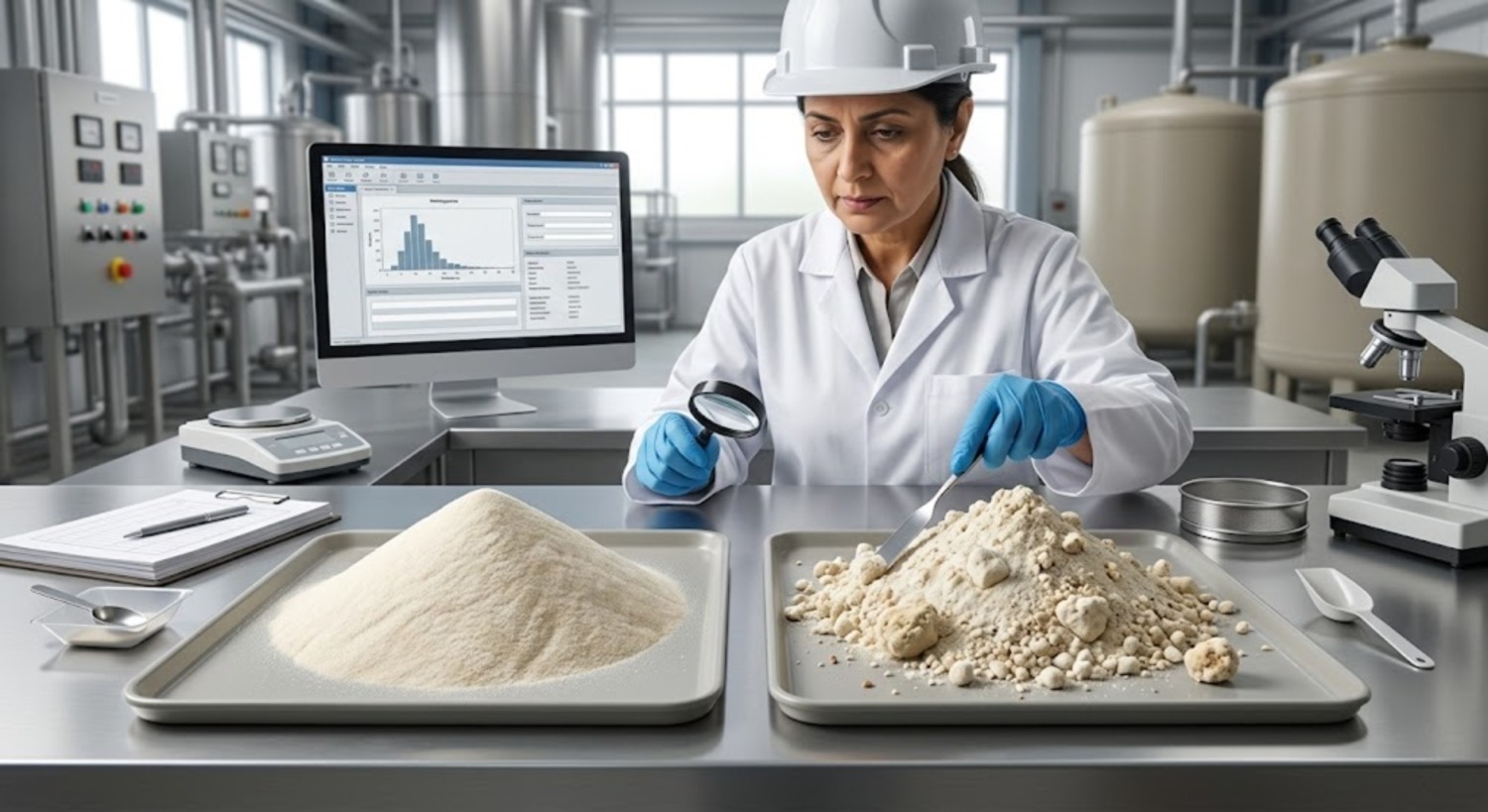
High-quality guar gum is processed to hydrate uniformly. Cheaper variants often struggle with “wettability.” When you dump low-grade powder into a mixing tank, it tends to form clumps known as “fish eyes”, dry powder encapsulated by a gel coating.
- The Cost: Your mixers have to run longer to break these clumps (energy cost).
- The Risk: Undissolved clumps can clog fine mesh filters and spray nozzles, forcing you to shut down the line for cleaning. One hour of production downtime costs significantly more than the few cents you saved on the raw material.
2. Inconsistent Viscosity = Rejected Batches
Gum quality is defined by its ability to provide consistent viscosity batch after batch. Cheap suppliers often blend crops or skip quality checks, leading to fluctuations.
- Scenario: You produce a sauce or a paint emulsion. One batch is perfect; the next is too runny because the gum’s potency dropped.
- The Result: You either have to re-work the batch (adding more gum and mixing again) or, worse, scrap the entire batch. Variability is the enemy of efficiency.
3. Filtration and Purity Issues
In industries such as oil and gas and pharmaceuticals, purity is non-negotiable. Cheaper guar gum often has a higher “acid-insoluble residue” (sand, hull, or dirt).
- The Impact: This residue is abrasive. It wears down pumps and equipment faster than pure gum does, leading to increased maintenance budgets that rarely get traced back to the raw material.
Comparison: Standard vs. Premium Guar Gum
To make this easier to visualise, here is how the two compare in a typical production environment:
| Feature | Low-Cost / Standard Guar Gum | Premium / MFT Quality Guar Gum |
| Active Galactomannan | Lower (< 75%) | Higher (> 82%) |
| Hydration Time | Slow, requires long mixing | Fast, rapid viscosity buildup |
| Dosage Required | High (to compensate for low potency) | Low (Cost-in-use is optimized) |
| Insolubles (Residue) | High (clogs filters) | Low (clean processing) |
| Batch Consistency | Variable | Guaranteed Consistency |
What Competitors Are Missing (The Content Gap)
When analyzing top-performing pages in this niche, we noticed a trend. Most content focuses on what guar gum is (a thickener) or where it is used (food, oil, paper). They miss the crucial operational aspect: Processability.
- Agro Gums focuses heavily on the versatility of the product.
- Scientific Journals focus on molecular structures.
What you need to know is the “Processability“: How easily does the powder disperse? Does it create dust? Does it foam excessively?
At MFTC, we focus on these operational metrics. We understand that a gum that creates excess foam requires you to buy anti-foaming agents, another hidden cost. Our gum is designed to integrate seamlessly into your existing machinery without requiring extra additives or extended mixing times.
How to ensure you are buying “True” Quality
Don’t just look at the price tag. When sourcing guar gum, ask your supplier for these three things:
- Viscosity Profile: Ask for a viscosity check at 2 hours and 24 hours. A cheap gum might thicken quickly but lose viscosity over time (depolymerisation).
- Mesh Size Distribution: Ensure the particle size is compatible with your equipment. Too fine might dust; too coarse might not dissolve.
- Fast Hydration Capability: If you have high-speed production lines, you need a “Fast Hydration” (FH) grade that achieves peak thickness in minutes, not hours.
Conclusion
Is cheaper guar gum costing you more? almost certainly. The additional usage, the wear on machinery, and the risk of inconsistent final products far outweigh the small savings on the purchase order.
Smart manufacturing isn’t about buying the cheapest ingredients; it’s about buying the most efficient ones.
Ready to optimize your production costs?
At MFTC, we don’t just sell powder; we sell consistency. Contact our technical team today to audit your current usage and see how a higher quality grade could actually save you money.
FAQs
1. What is guar gum?
Guar gum is a common additive used in processed foods.
2. How to dissolve guar gum in water?
To dissolve guar gum in water without clumping, slowly sprinkle the powder into the water while using high-shear agitation (blender, whisk, or mixer).
3. How to make guar gum?
Guar Gum, also known as Guaran, is made from the seeds of the cluster bean plant.
Leave a Reply