
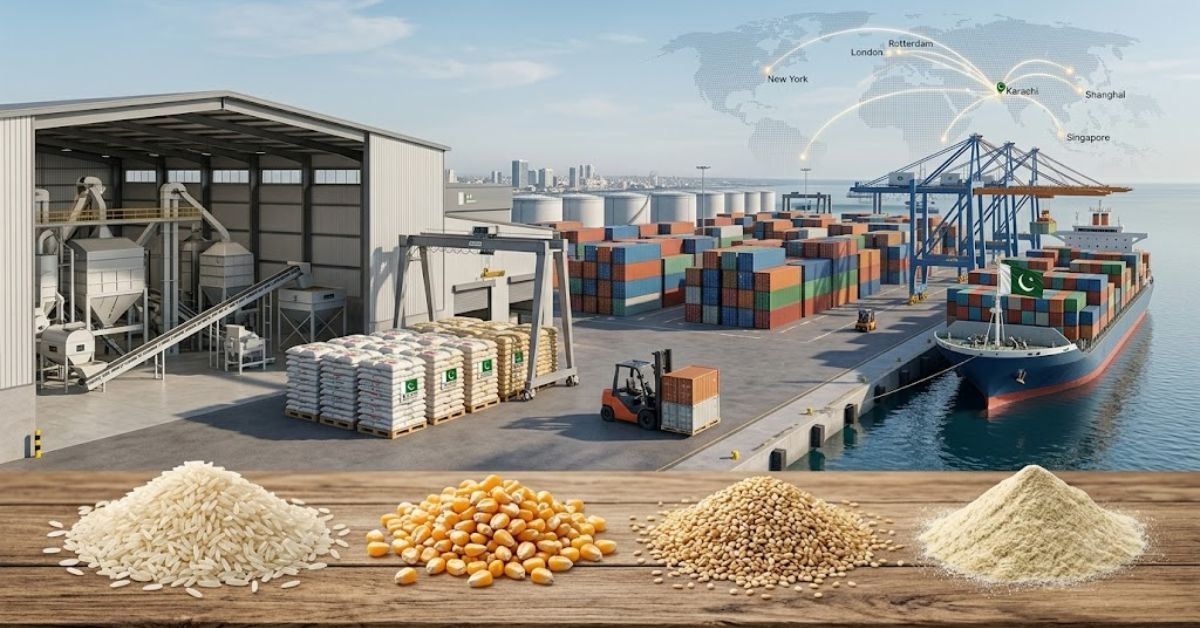
One Business, Many Product Lines
Some exporters stick to a single commodity. MFTC took a different route, building several product lines under one roof, anchored by its long-standing strength in rice.
Having dedicated processing and quality systems for each line, it makes a company far more resilient and a lot more useful to buyers who need more than one product. MFTC was first known for rice, and now it is positioned as a diversified agro-exporter. So what exactly sits under that roof?
What MFTC Exports
MFTC’s core business units are rice, guar gum, and sesame seeds, along with feed corn and other grains, such as:
- Rice: Premium Basmati and non-Basmati rice under its registered brand Naubahar. This is MFTC’s heritage line, and part of the reason we’re recognised as one of Pakistan’s largest rice exporters.
- Guar gum: Processed through MFTC’s Guar Division in food-grade, pharmaceutical-grade, and industrial-grade viscosities.
- Sesame seeds: A core export line serving food processing markets, and it’s a big part of why global buyers prefer sourcing Pakistani sesame seeds in bulk.
- Feed corn: Supplies the livestock and poultry feed sector.
- Other agri-commodities: Including wheat, soybean meal, canola meal, and rapeseed meal.
So MFTC is a specialist and a one-stop source at once: a rice exporter, a guar gum exporter, and a sesame seeds exporter, all inside the same trusted business. It’s also the authorized dealer of Kubota agricultural machinery in Pakistan, which ties the whole operation back to the farm. But listing products is the easy part. Running them all well together is where it gets difficult.
How a Multi-Line Export Business Works
Managing several export lines isn’t just doing one thing five times over, it’s a coordinated operation. MFTC runs on a vertically integrated supply chain that covers every stage from farm to plate:
- Procurement of grains from farming regions across Pakistan
- Milling and processing
- Packaging tailored to each commodity
- Warehousing and storage, including massive storage at the port
- Shipping and export to over 150 destinations across all continents
The commodities differ, but the discipline behind them — sourcing, processing, testing, and shipping — is what ties the whole business together. MFTC originates, processes, and transports roughly one million tons of products a year, which only works because that chain is controlled from the beginning to the end, just to keep their quality consistent.
Keeping Quality Consistent Across Every Line
Here’s the fair question a buyer should ask: Does spreading across many lines mean weakening the quality of each product?
For MFTC, the answer is no because quality is managed per line and backed by certifications that apply across the business.
MFTC oversees quality control at every stage, from cultivation to export, through its vertically integrated setup. It’s an SRP (Sustainable Rice Platform) Verified Business with end-to-end traceability on rice, and it holds globally recognised quality and food-safety certifications including HACCP, ISO 9001, BRCGS, IFS, Kosher, and Halal, along with Sedex certification.
Each commodity carries its own standards and testing; consistency across every line, not just the flagship one, is what separates a real diversified exporter from a middleman. Which is exactly why buyers go looking for a diversified partner in the first place.
Why Buyers Prefer a Diversified Exporter
For international buyers, a diversified exporter quietly solves a lot of headaches:
- Source several products, such as rice, guar gum, sesame, and corn, from one trusted partner instead of chasing many
- One relationship, one set of paperwork, one point of contact
- Consistent standards and communication across every product
- A more stable supplier that isn’t tied to the ups and downs of a single crop
In short, less risk, less hassle, and one company that already knows how to get Pakistani products to the world reliably to over 150 destinations. That’s the whole idea behind how MFTC operates.
Why It Works: The MFTC Approach
This is the model Meskay & Femtee Trading Company is built on: multiple product lines, each with its own processing and quality discipline, under one experienced, fully integrated export business in Pakistan.
Trusted as a name since its foundation. Headquartered in Karachi with five strategically located processing facilities across Sindh and Punjab, MFTC gives buyers access to several commodities, certified quality control, and export reach across 150-plus destinations worldwide. In other words, it’s not just moving grain, it owns the supply chain that stands behind it. Tell us what you’re sourcing, and we’ll help you get it reliably and to standard.
Many products. One reliable export partner.
From rice to guar gum to sesame seeds, Meskay & Femtee Trading Company (MFTC) supplies multiple quality-controlled product lines from Pakistan so global buyers can source more from one trusted, certified exporter.
FAQs
1. What products does MFTC export?
A: Meskay & Femtee Trading Company exports rice (Basmati and non-Basmati), guar gum, sesame seeds, and feed corn, along with other grains like wheat and oilseed meals. Its core business units are rice, guar gum, and sesame seeds, serving food, feed, and industrial markets worldwide.
2. How do export companies manage multiple product lines?
A: Companies manage multiple product lines through dedicated sourcing networks, per-line quality control, and shared logistics and export expertise. MFTC does this with a vertically integrated supply chain covering procurement, milling, packaging, warehousing, and shipping, so each commodity is handled to its own standard from farm to export.
3. Why choose a diversified export supplier?
A: A diversified supplier lets buyers source several products from one trusted partner, with one relationship and consistent standards. It also means a more stable supplier that isn’t dependent on a single crop, reducing risk and simplifying international sourcing.
4. What industries does MFTC serve?
A: MFTC serves food processing, livestock and poultry feed, and industrial sectors worldwide, supplying rice and sesame to food markets, feed corn to the livestock industry, and food-, pharmaceutical-, and industrial-grade guar gum to a range of commercial buyers.