
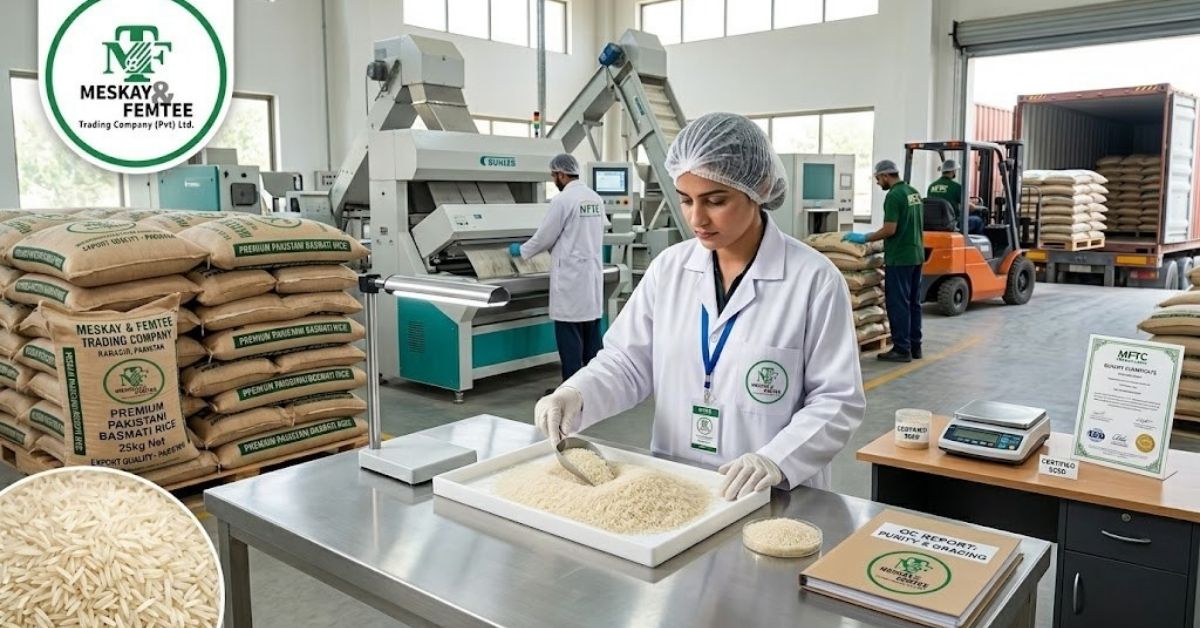
Let’s look at the reality of the global rice trade for a second. In FY 2024-25, the Pakistan Rice Industry exported over 5.54 million metric tons of rice, valued at a massive $3.2 billion. Interestingly, Basmati rice exports to the EU alone grew by 15% during that exact same period. But behind every single successful shipment, there is one non-negotiable factor: rice purity protocols.
When you are importing in bulk, rice export quality isn’t just a marketing buzzword; it’s a strict regulatory requirement. Failing to meet the rice quality standards set by Pakistan and international authorities may mean delayed shipments, rejected containers, and heavy financial losses. This guide breaks down exactly what purity means, how it is tested on the ground, and why a pure basmati rice export starts long before the grain even reaches the port.
At Meskay & Femtee, we’ve been exporting rice to over 150 destinations for two decades, processing a million tons annually, so we understand exactly what importing rice from Pakistan.
Why Rice Purity Defines Pakistan’s Export Reputation
Pakistan accounts for roughly 35% of the global Basmati rice trade, making quality assurance a critical part of the country’s rice export industry. With exports hitting the $3.2 billion mark recently, the EU, China, and the Middle East remain the top three destination markets.
But here is the catch: markets like the EU and the UK have incredibly strict import controls regarding rice purity. If a shipment fails a DNA purity test at a European port, that’s not just a minor headache for the buyer. It’s a total shipment rejection. Pakistan’s growing reputation as a reliable, premium supplier depends entirely on consistent purity compliance, shipment after shipment.
That is why Meskay & Femtee has focused on building long-term relationships with buyers. Sustained success in the rice trade comes from consistent, certifiable quality under the Rice Exporters Association of Pakistan (REAP), not just offering the lowest competitive pricing.
What Does Rice Purity Actually Mean?
So, what are we really measuring here? Well, rice purity isn’t just a single magic number on a piece of paper. It is a comprehensive, multi-parameter assessment.
For a true, pure basmati rice export, purity means the grain actually meets several strict criteria. It must be a genuine Basmati variety, meaning it hasn’t been quietly blended with inferior, cheaper non-Basmati rice. It also needs to be perfectly within specification for grain length, moisture levels, and broken percentage. Crucially, it must be completely free from artificial colouring or polishing agents.
The real test, however, is the aroma. Authentic Basmati contains a natural aroma compound called 2-acetyl-1-pyrroline (2-AP) at 0.09 ppm or above. Basmati grains naturally contain about 12 times more of this compound than non-Basmati varieties. It’s the ultimate marker of authenticity. And scientifically speaking, Basmati-type rice only exhibits its absolute best grain quality when grown in Pakistan’s Punjab region, where the environmental factors simply cannot be replicated.
What Makes Pakistani Basmati Rice High Quality?
If you want to understand the rice quality standards Pakistan enforces, you have to look at the geography. Pakistan’s Punjab region, specifically the “Kalar bowl” situated between the Ravi and Chenab rivers, provides the exact warm, humid, valley-like climate required for optimal grain elongation and aroma development.
When looking at Pakistan’s rice quality, here are the specific indicators that define a premium batch, rather than just a standard one:
- Pre-cooked grain length: Minimum 6.61mm (for milled grains). This is the baseline that determines the grade classification.
- Post-cooking elongation: Minimum 1.7x (non-parboiled). This dictates the texture and overall buyer preference.
- Aroma compound (2-AP): Must be ~0.09 ppm naturally. This is your primary authenticity marker.
- Moisture content: Maximum 14%. Anything higher, risks spoilage during storage and ocean freight.
- Broken grains: Maximum 5% for top export grades. This ensures a high commercial yield for the buyer.
- Non-Basmati admixture: Maximum 15% (industry standard). This is the absolute limit for purity compliance before a batch is downgraded.
(Sources: Eurofins Scientific, Grainka Export Quality Guide, EU Commission Regulation 2023/2835).
Understanding these metrics is the first step in ensuring a pure basmati rice export.
Discover the MFTC Naubahar Rice Brand
Key Rice Quality Standards Pakistan Exporters Must Meet
The rice quality standards exporters must navigate depend heavily on where the container is going. Ensuring rice export quality means adapting to the specific regulatory framework of the destination port.
Here is a breakdown of the critical governing standards by market:
- Pakistan (Domestic/Export): Governed by the PSQCA and PHDEB. The key requirement is a clean Phytosanitary certificate for every single shipment leaving the port.
- European Union: Governed by EU Commission Reg. 2023/2835. The EU requires a mandatory DNA purity test and strict Basmati variety registration. Non-registered varieties simply will not clear customs.
- United Kingdom: Governed by the UK Basmati Code of Practice (which REAP is a signatory to). Any rice labelled “Product of Pakistan” must contain a minimum of 97% grains of genuine Pakistani origin.
- Middle East / Gulf: Driven mostly by individual importer specifications, though standard requirements strictly cap moisture at 14% and broken grains at 5%.
- USA: Monitored via FDA Import Alert guidelines. Importers must provide comprehensive pesticide residue testing alongside standard phytosanitary documents.
Membership in REAP is a strong market signal here. Buyers in the EU and UK actively verify their supplier’s REAP affiliation to ensure compliance. At Meskay & Femtee, we operate in total compliance with all destination market standards, and we always make our documentation fully available to our buyers.
Request quality compliance documentation.
How Is Basmati Rice Purity Tested?
Testing rice purity in Pakistan exports isn’t guesswork. To guarantee a pure basmati rice export, the Pakistan Rice Industry relies on five distinct testing phases:
- Physical Inspection: This is the fast, first-line check. Assessors measure grain length, count broken grains visually, check for colour uniformity, and identify any foreign matter.
- Aroma Sensory Test: Trained human assessors evaluate the natural 2-AP fragrance. This quickly distinguishes genuine Basmati from cheaper, non-aromatic long-grain varieties.
- Moisture Testing: Standard moisture meters are used to ensure the batch hits that critical 12–14% target for export-grade stability.
- Chemical / Lab Analysis: A deeper dive checking ash content, amylose levels, uric acid, and critical aflatoxin screening.
Learn more about MFTC’s From Farm to Plate process
How Can You Check Rice Purity as a Buyer?
So, as an importer, how do you actually verify the rice purity that a Pakistani exporter claims before you transfer funds? Ensuring rice quality comes down to a few very practical steps:
- Step 1: Always request a physical sample before confirming the order. Check the grain length, colour uniformity, and natural aroma yourself.
- Step 2: Ask for third-party test certificates. Specifically, request an SGS or Bureau Veritas report covering moisture, broken percentage, and foreign matter.
- Step 3: If you are an EU or UK buyer, insist on a DNA purity certificate for Basmati orders to detect admixture.
- Step 4: Verify the supplier’s REAP membership. Active members are subject to industry oversight, which adds a layer of security.
- Step 5: Put your purity tolerances directly into the contract. Specify your maximum moisture, broken percentage, and non-Basmati admixture limits in writing before any payment is made.
At Meskay & Femtee, we provide all five of these verification steps as standard practice. We don’t hide our metrics.
The Adulteration Problem And How Pakistani Exporters Address It
Adulteration is the single biggest risk to pure basmati rice export credibility. Mislabelling non-Basmati rice as Basmati actually accounts for an estimated 15–20% of global Basmati trade disputes (FSSAI / EU Rapid Alert System, 2024).
Adulteration usually happens in a few ways. Sometimes suppliers mix lower-grade IRRI rice with genuine Basmati. Other times, they blend older stock with fresh crops to hide quality differences, or even use artificial fragrance sprays to mimic that natural Basmati smell.
Reputable exporters strictly follow the rice quality standards Pakistan enforces to combat this. They maintain variety-specific storage facilities so cross-contamination doesn’t happen. They provide DNA certificates upfront. Under the UK Code of Practice, when Basmati is marked with a specific variety, it must legally constitute at least 97% of the batch content (UK CoP, 2017). At Meskay & Femtee, we source rice directly from verified farmers, meaning zero third-party blending and full provenance documentation.
How Meskay & Femtee Ensures Rice Purity at Every Stage
Rice purity in Pakistan isn’t something you can just inspect at the port; it has to be controlled from the moment the seed goes into the ground. If you want a truly pure basmati rice export, the supply chain has to be watertight.
Here is how we ensure rice quality at Meskay & Femtee:
- Farm: We work with certified farmers using variety-controlled planting.
- Procurement: We use direct sourcing. No third-party blending, ever.
- Milling: Cleaning, sorting, and precision grading happen on-site at our facilities.
- Testing: We run rigorous pre-milling and post-milling quality checks and provide third-party certificates.
- Packaging: Sealed, export-compliant packaging that protects the grain.
- Shipping: Phytosanitary-certified shipments loaded directly at Karachi port.
Processing 1 million tons annually gives us the scale to maintain rigorous quality consistency. With IFS Food and other major certifications held, we fully document every single shipment.
Key Takeaways
-
-
- Rice purity in Pakistan is a multi-parameter standard, not just a single metric or visual check.
- Top grades require a minimum 6.61mm grain length, max 14% moisture, max 5% broken grains, and max 15% non-Basmati admixture.
- DNA fingerprinting (RT-PCR) detects adulteration down to 1% and is now standard for EU-bound shipments.
- The Pakistan Rice Industry exported $3.2 billion worth of rice in FY 2024-25, driven by consistent export quality and compliance with international standards.
- Meskay & Femtee verifies purity from farm to port, offering a pure basmati rice export with full documentation provided on request.
-
FAQs
1. How can you check rice purity?
A: There are numerous ways to check rice purity, like sample testing, verifying the exporter’s certifications from local and international bodies, and conducting physical inspection, such as rice length testing, aroma testing, and moisture testing.
2. What makes Pakistani rice high-quality?
A: Pakistani rice has a unique combination of long-grain texture, intense natural aroma, and fluffy texture after cooking, which is why it is very well known and a prime export product globally.
3. How is basmati rice purity tested in Pakistan?
A: The purity of rice is tested via physical inspection, which involves moisture checking, its aroma, and even lab testing.
Leave a Reply