
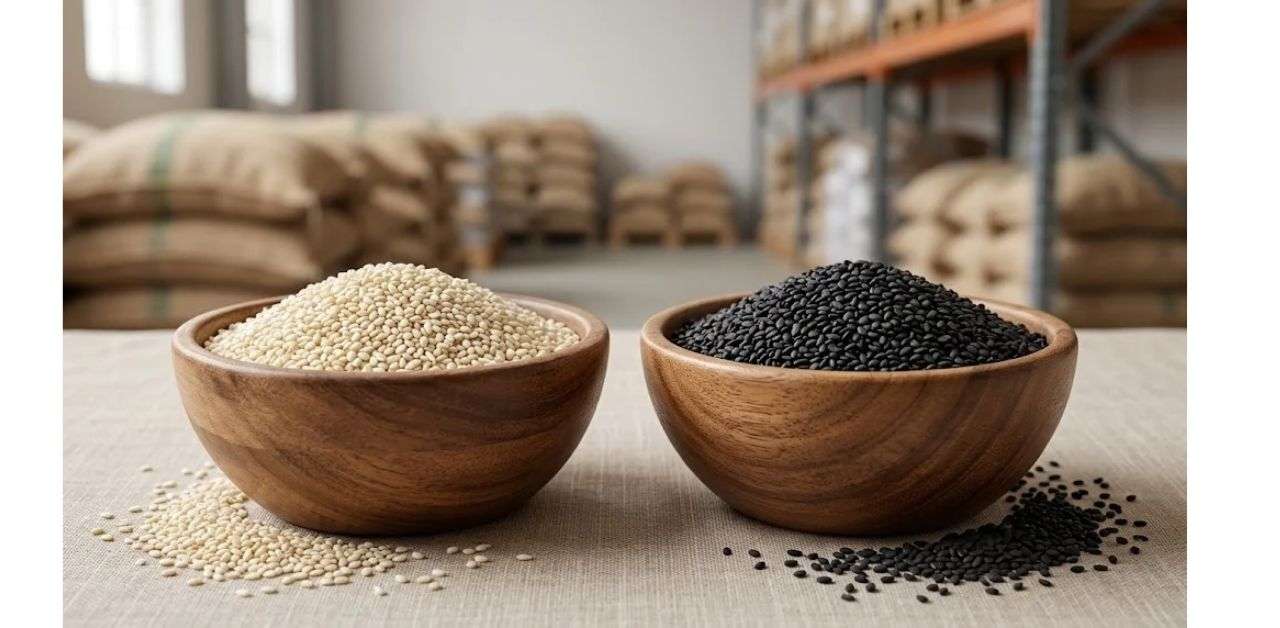
Sesame seeds are available in several varieties, and for food manufacturers, importers, and traders, it is not just a product, but a choice that influences the taste, price, and appearance of the end product. White and black sesame seeds are grown on the same plant, but are very different in terms of their use in food processing. This guide provides details on tbhe actual taste, cost, and usage, helping buyers choose the variety that is right for them.
Table of Contents
Same Plant, One Key Difference
White and black sesame seeds are both derived from the same plant, Sesamum indicum. Though they come from the same plant, they differ in terms of their processing. White sesame is hulled, which means that its outer shell is removed to expose the light colored inner seed. Black sesame seeds are left with the black outer seed coat, keeping their natural dark outer hull.
This unique feature, whether hulled or unhulled, is the one thing that propels everything else. Removing the hull (whitening) or retaining the hull (black) affects the colour, texture, and nutritional content of the seed, which in turn affects the taste and therefore the market value and optimal usage of these seeds. This knowledge is fundamental to making the other comparison easy.
Difference in Taste and Texture
The taste difference comes directly from the hull. Here’s how the two compare:
- White sesame seeds: mild, slightly sweet, and nutty, with a smooth, creamy texture. They blend into foods without overpowering them.
- Black sesame seeds: bolder, earthier, and more robust, with a slightly crunchier texture from the intact hull. They add a distinct taste and visible colour.
For a food manufacturer, this difference matters commercially:
- A neutral seed (white) disappears into a product, ideal when you don’t want the sesame to stand out.
- A bold seed (black) adds colour and character, ideal when the sesame is meant to be noticed.
Neither is “better.” They simply suit different applications.
Difference in Nutrition
When it comes to sesame seeds benefits, both varieties are nutrient rich, but the hull gives black sesame a slight edge:
- Black sesame: keeps its hull, and the hull holds most of the minerals, so it’s generally higher in calcium, iron, fibre, and antioxidants.
- White sesame: still nutritious, just marginally lower in these minerals because the hull is removed.
The difference is real but modest. For buyers, nutrition usually matters most for health focused products specifically, rather than being the deciding factor for every application.
Difference in Price
Black sesame seeds are generally more expensive than white, and there are clear reasons why. The table below breaks it down:
For a buyer, the takeaway is simple: white sesame is the more economical choice for large volume manufacturing, while black sesame carries a premium. The right pick is partly a cost decision, weighed against what the end product actually needs.
Best Uses: Which Seed for Which Product
This is where the difference matters most for buyers, because each seed suits different products. Matching the seed to the application is what protects both cost and quality.
- White sesame seeds are the standard choice for bakery products, bread rolls, burger buns, and general food processing, where a neutral colour and mild taste are needed. They are also the base for tahini and sesame paste.
- Black sesame seeds are preferred for Asian cuisine, sushi, desserts, and dishes where their colour and bold flavour are the point. They are also widely used for sesame oil and in premium and health focused products.
In short: choose white when the seed should blend in, and black when it should stand out.
White vs Black Sesame Seeds: A Comparison
The table below summarises the key differences for buyers at a glance.
| Feature | White Sesame Seeds | Black Sesame Seeds |
|---|---|---|
| Processing | Hulled (shell removed) | Unhulled (hull retained) |
| Taste | Mild, sweet, nutty | Bold, earthy, robust |
| Texture | Smooth, creamy | Slightly crunchy |
| Nutrition | Rich; slightly lower minerals | Higher calcium, iron, fibre |
| Price | Generally lower, high volume | Generally higher, premium |
| Best for | Bakery, buns, tahini, processing | Asian cuisine, oil, premium products |
The simplest way to read this: white sesame is the versatile, cost effective option, while black sesame is the premium, characterful choice.
How Buyers Should Choose
For a food manufacturer or importer, the right seed depends on the end product, not on which is “best.” A bakery supplier and a premium health food brand will make different, equally correct choices.
When sourcing, buyers should weigh a few points:
- The end product — will the seed blend in (white) or stand out (black)?
- Cost and volume — white is usually more economical for high volume lines
- Quality and grade — best quality sesame seeds are clean, uniform, and low in moisture, whichever colour you choose
- Consistency — the seed should perform the same in every shipment
Confirming these with a supplier upfront avoids receiving the wrong grade for the product.
Sourcing Sesame Seeds from Pakistan
Pakistan is a major sesame producer and one of the world’s leading exporters, supplying both white and black sesame to international markets. For buyers, sourcing from an established Pakistani exporter offers access to quality seed in both varieties, backed by proper processing and documentation.
As a trusted sesame seed supplier in Pakistan and one of the established sesame seed exporters in Pakistan, MFTC supplies clean, well graded white natural sesame seeds to specification, with the consistency and export documentation international buyers require.
To request a quotation or samples, contact the MFTC team.
FAQs
1. What is the difference between white and black sesame seeds?
A: White sesame seeds are hulled, giving a mild taste and smooth texture. Black sesame seeds keep their hull, giving a bolder flavour, crunchier texture, and higher mineral content.
2. Which has a stronger taste, white or black sesame?
A: Black sesame has the stronger, bolder, earthier taste because it keeps its hull, while white sesame is milder and slightly sweet.
3. Are black sesame seeds more expensive than white sesame seeds?
A: Yes, generally. Black sesame is a smaller share of global production and carries a premium positioning, so it usually costs more than white sesame.
4. Which sesame seed is preferred for food processing?
A: White sesame seeds are usually preferred for general food processing, bakery, buns, and tahini since they have a milder taste.
5. How do buyers identify good quality sesame seeds?
A: By checking purity, uniform colour and size, low moisture content, and proper cleaning and grading, ideally confirmed with documentation from the supplier.
6. Are white and black sesame seeds available for export from Pakistan?
A: Yes. Pakistan is a major sesame exporter and supplies both white and black sesame seeds to international markets, available in export grade quality from established suppliers.
7. What should international buyers specify when ordering sesame seeds?
A: The variety, grade and purity, moisture content, quantity and packaging, and destination, so the supplier can provide the correct product and an accurate quote.