
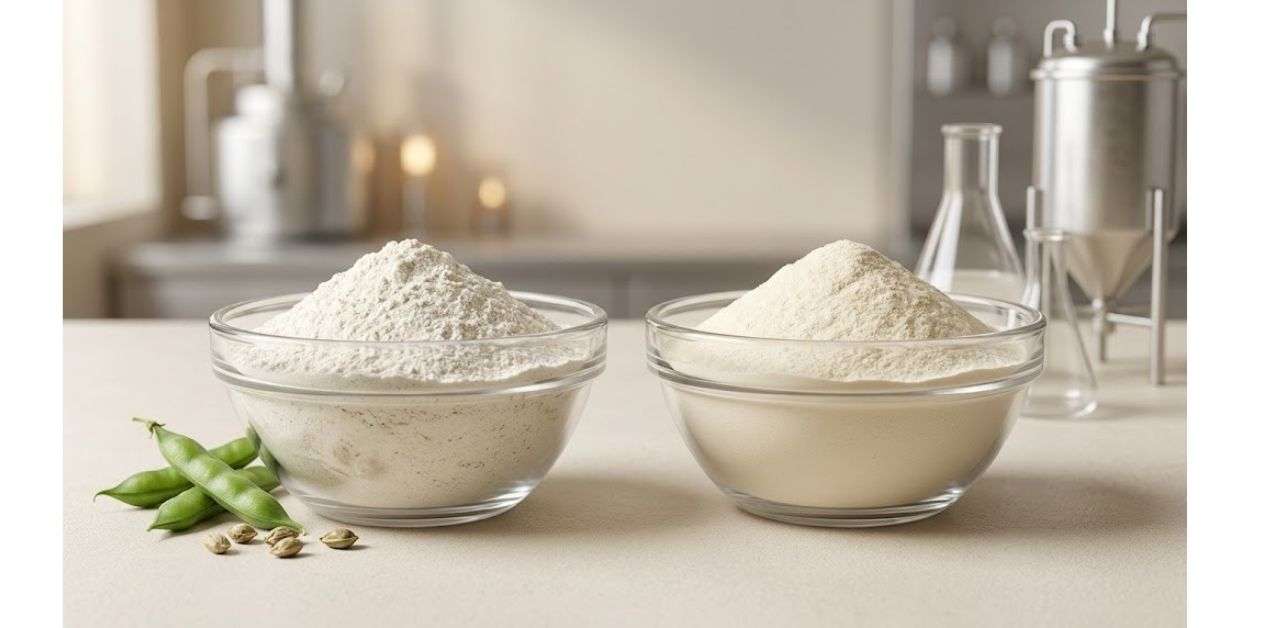
For formulators and manufacturers, choosing a thickener is not a small decision, it affects texture, stability, cost, and how a product behaves on the shelf. Guar gum and xanthan gum are the two most common choices, and while they can seem interchangeable, they perform very differently under real conditions. This guide explains what each one is, how they differ, and which works better in which situation, so buyers can make an informed, cost effective choice.
Table of Contents
What Is Guar Gum?
Guar gum is a natural, commonly used food and industrial thickening agent. Here’s the quick picture:
- What it is: a natural thickener and stabiliser, sold as fine guar gum powder.
- Where it comes from: the seed of the guar plant, grown mainly in India and Pakistan, which is why guar gum in Pakistan is widely produced for export.
- How it works: dissolves in cold water; has roughly eight times the thickening power of cornstarch, so a little goes a long way, which keeps it cost-effective.
- Best suited to: neutral pH / ambient temperature products.
- Limitation: Becomes less viscous under conditions of excessively high acidity (pH< about 5) and elevated temperatures.
What Is Xanthan Gum?
Xanthan gum is also a thickener, but it’s made in a completely different way. In short:
- What it is: a thickener and stabiliser, sold as a fine powder.
- Where it comes from: made by bacterial fermentation of sugars, not from a plant unlike guar gum.
- Main strength: stability. It holds viscosity across a very wide pH range (roughly 1 to 13), a broad temperature range, and through freezing and thawing.
- Where it works best: acidic, salty, heat treated, or frozen products, and it thickens strongly even at low doses.
- Trade-off: tends to be more expensive than guar gum.
The Core Differences
The two gums differ in origin, stability, and cost, and those differences decide which suits a given product. The table below sets them side by side.
| Feature | Guar Gum | Xanthan Gum |
|---|---|---|
| Source | Guar plant (galactomannan) | Bacterial fermentation |
| Cost | Lower, very cost effective | Higher |
| pH stability | Best near neutral; weak below pH 5 | Stable across pH 1–13 |
| Heat stability | Reduced at high heat | Stable across a wide range |
| Freeze thaw | Less stable | Very stable |
| Thickening | Strong, high yield | Very strong at low doses |
| Best conditions | Neutral, ambient products | Acidic, heat treated, frozen products |
In short: guar gum wins on cost in the right conditions, and xanthan wins on stability in demanding ones.
Industrial Uses of Each
Both gums are used far beyond food, though their properties suit different roles. Here is where each is commonly applied:
- Guar gum is used in food (bakery, sauces, dairy, beverages), and heavily in oil and gas drilling, textiles, paper, mining, and cosmetics, wherever cost effective thickening at neutral pH is needed.
- Xanthan gum is used in acidic and demanding food products (salad dressings, sauces, gluten free bakery), plus pharmaceuticals, cosmetics, and drilling fluids, wherever stability across pH and temperature is critical.
There is significant overlap, but the deciding factor is almost always the product’s conditions and the budget.
Guar Gum vs Xanthan Gum: Which Is Better?
There is no single winner, and any supplier who tells you otherwise is oversimplifying. The right choice depends entirely on the formulation. As a rule of thumb:
- Choose guar gum when the product is neutral in pH, used at ambient temperature, and cost is a priority, for example many culinary sauces and baked goods. It delivers strong thickening at a lower price.
- Choose xanthan gum when the product is acidic, heat treated (pasteurised or UHT), frozen, or needs a long, stable shelf life. Its stability justifies the higher cost.
For great neutral, cost sensitive applications, guar gum is genuinely the smarter, more economical choice. The key is matching the gum to what the product must actually withstand.
When They Work Better Together
Here is something many buyers do not realise: guar gum and xanthan gum are not always rivals. Used together, they work synergistically, the combination produces a higher viscosity than either gum alone at the same total dose.
This is why many commercial formulations use a blend of both. Guar provides cost effective bulk thickening, while xanthan adds stability, and together they can deliver better texture and performance, often more economically than using xanthan alone. For a formulator, the real question is frequently not “which one,” but “in what ratio.”
What Buyers Should Consider
For a manufacturer or importer, choosing between these gums, or blending them, comes down to a few practical points:
- Product conditions — the pH, temperature, and shelf life the gum must survive
- Cost and dosage — guar is usually more economical where conditions allow
- Grade and specification — viscosity grade and particle size must match the application
- Consistency and purity — the gum should perform identically in every batch
- Reliable supply — choose guar gum suppliers with a dependable source and consistent output, since supply matters most for guar
Confirming these with a supplier upfront ensures the right product for the formulation, at the right cost.
Sourcing Guar Gum from MFTC
For buyers who need guar gum specifically, sourcing from a specialist producer matters. Through its dedicated guar gum division, MFTC manufactures and exports food-grade and industrial-grade guar gum powder in Pakistan to consistent, verifiable standards.
As one of Pakistan’s established guar gum manufacturers and exporters, MFTC supplies clean, well graded guar gum powder in the viscosity grades different industries require, from food to drilling, backed by proper manufacturing standards and full guar gum export documentation. If guar gum is the right fit for your product, or part of a guar xanthan blend, MFTC can supply the grade you need. To request a quotation or samples, contact the MFTC team.
FAQs
1. What is the difference between guar gum and xanthan gum?
A: Guar gum is a plant based thickener from the guar seed; xanthan gum is made by bacterial fermentation.
2. When is guar gum better than xanthan gum?
A: Guar gum is better for neutral pH, ambient temperature products where cost matters, such as many sauces and baked goods. It delivers strong thickening at a lower price than xanthan.
3. Which industries commonly use guar gum?
A: Food, oil and gas drilling, textiles, paper, mining, and cosmetics, wherever cost effective thickening is needed.
4. Does guar gum have different grades for different applications?
A: Yes. Guar gum comes in different viscosity grades and particle sizes, food grade for food products and industrial grades for applications.
5. How does guar gum viscosity compare with xanthan gum?
A: Both are strong thickeners. Xanthan reaches high viscosity at very low concentrations and stays stable, while guar gives strong, cost effective thickening but loses viscosity in acidic or high heat conditions.
6. What should buyers consider when choosing between guar gum and xanthan gum?
A: The product’s pH, temperature, and shelf life needs, the budget, the required grade, and consistency of supply. Often, a blend of both gums gives the best result.
7. Can guar gum be sourced from Pakistani manufacturers for export?
A: Yes. Pakistan is a major guar producer, and established manufacturers export food grade and industrial grade guar gum powder to international markets with export documentation.