
When a buyer places a bulk rice order, the mill behind that order determines whether it ships on time and arrives at a consistent quality and grade. Processing capacity, milling technology, and quality control are the three factors that decide this and are worth keeping track of before an order is confirmed.
This article explains MFTC’s milling operation in practical terms: what processing capacity means, how our mill is equipped, the quality checks applied at each stage, and what all of this means for your delivery timeline. For a stage-by-stage account of how rice itself is milled, our guide to the rice milling process covers each step in full.
1. What Rice Processing Capacity Means
Rice processing capacity is the amount of paddy a mill can convert into clean, export-ready rice within a set period, usually measured in tons per day or per year. It is a direct measure of how much volume a supplier can handle without delay.
For a bulk buyer, capacity matters more than almost any other single factor. A mill operating close to its limit cannot absorb a large order without postponing delivery, while a mill with genuine headroom can take on high volume and still meet the agreed schedule. This is why experienced buyers confirm capacity before they discuss price.
2. MFTC’s Milling Operation and Capacity
MFTC operates an integrated rice milling operation in Pakistan, processing paddy sourced through its own farm-to-plate supply network into finished export-grade rice. The operation is built for scale, with the capacity to process approximately 1,000,000 MTs [X tons of rice per year]. [MFTC to confirm the exact annual figure — this is the central fact of the article and must be accurate before publishing.]
This capacity has a direct benefit for buyers: it allows MFTC to commit to large and recurring orders with confidence. When a buyer requires a fixed volume on a regular schedule, the capacity to produce it is already in place, rather than being outsourced to a third-party mill. The full range of rice produced through this operation is available on our rice products page.
To put that scale in context, Pakistan has an estimated 1,000 to 1,500 rice mills, of which more than 500 are export-grade, and the country ranks among the world’s top five rice exporters. An integrated operation positioned within that export tier is what allows MFTC to serve international buyers reliably.
3. The Milling Technology and Process
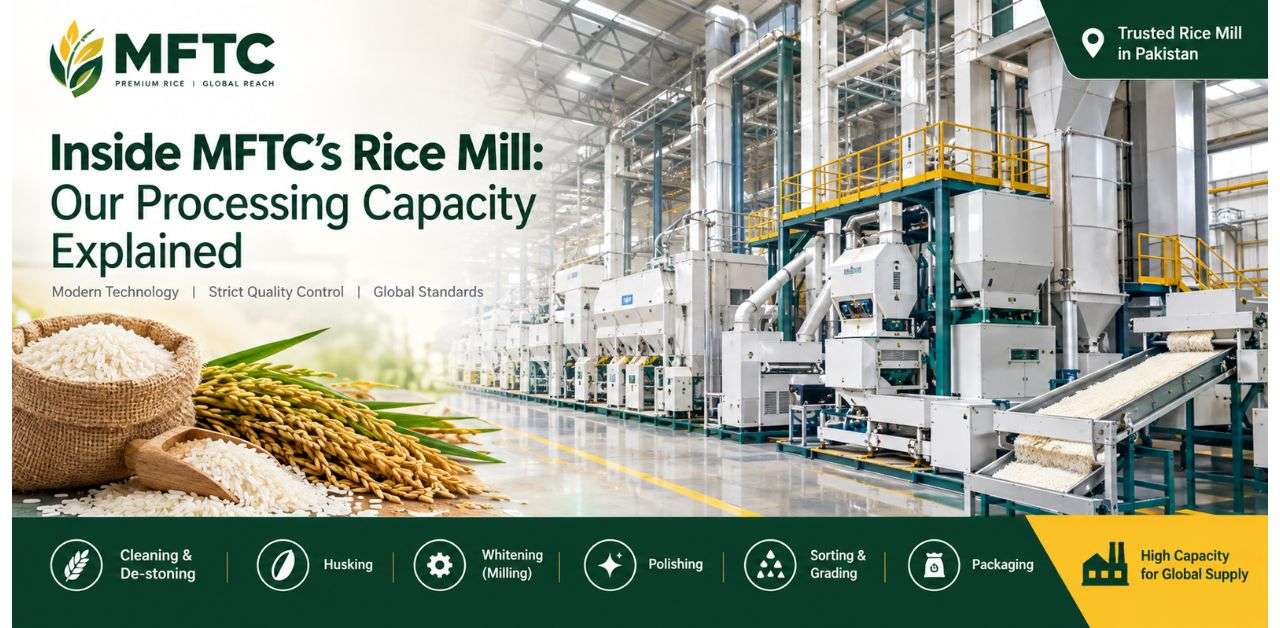
A modern rice mill is a sequence of specialised machines, each responsible for one stage of turning paddy into finished rice. MFTC’s operation covers the complete process:
- Cleaning and de-stoning: removing straw, dust, stones, and foreign material from the raw paddy.
- Husking: stripping the outer husk to produce brown rice.
- Whitening (milling): removing the bran and germ to produce white rice, using multistage milling to reduce breakage.
- Polishing: refining the grain to its final finish and improving shelf life.
- Sorting and grading: separating grain by size, shape, and colour, with optical sorters removing discoloured or defective grains.
- Packaging: packing to the buyer’s specification for protection and traceability.
The value of this technology is consistency. Multistage milling reduces the proportion of broken grains, and optical colour sorting removes defects the human eye would miss at volume. Together they are what keep a large order uniform from the first bag to the last.
4. Quality Control Throughout the Process
Quality control at MFTC is applied at every stage of milling, not as a single inspection at the end. At each step, rice is checked against the buyer’s agreed specifications for moisture, broken percentage, polish, and purity.
This approach matters because quality issues are far less costly to correct during milling than after a shipment has left port. Continuous control is also what allows the operation to meet the international food-safety standards that many destination markets require. Buyers can review MFTC’s full quality and certification standards on our quality page. For buyers, these standards are documented assurance that every batch meets a controlled specification.
5. How Capacity Affects Your Delivery Timeline
Processing capacity connects directly to delivery speed. A mill with available capacity can begin production promptly and hold to the agreed loading schedule, whereas a mill already at its limit will place a new order in a queue behind existing ones.
Because MFTC’s operation is built for volume, production can be planned efficiently, and the bottlenecks that delay smaller, single-line mills are avoided. For a buyer, this is the difference between a delivery date that can be relied upon and one that is subject to change. The scale of an established operation is precisely what protects a committed timeline, a point examined further in our overview of the rice mill industry in Pakistan.
6. How MFTC Compares to Other Rice Mills in Pakistan
Pakistan’s rice mills range from small, localised operations to large integrated exporters, and for a buyer, the practical difference comes down to three factors: capacity, quality control, and reliability of delivery.
Smaller mills may offer competitive pricing but often struggle to handle bulk volume, maintain consistency across a large order, or meet the certifications that export markets demand. MFTC’s advantage is an integrated operation sourcing paddy through its own supply chain, milling it in-house, and controlling quality at every stage, which allows it to commit to both a delivery date and a consistent grade at the same time. The complete supply journey is set out in our farm-to-plate overview.
Conclusion
Processing capacity, milling technology, and quality control are what turn a quotation into a shipment that arrives on time and to specification. MFTC brings all three together in a single integrated operation, which is why international buyers sourcing bulk Pakistani rice choose to work with us.
To discuss your required volume, specifications, and delivery schedule, or to request a quotation, contact MFTC today.
Frequently Asked Questions
1. What is MFTC’s annual rice processing capacity?
A: MFTC operates an integrated milling operation capable of processing approximately 1,000,000 MTs [X tons of rice per year]. [Confirm figure.] This scale allows MFTC to fulfil large and recurring export orders on a fixed schedule.
2. What equipment and technology does MFTC’s rice mill use?
A: MFTC’s operation covers the full process cleaning, husking, multistage whitening, polishing, and optical sorting and grading. Multistage milling and colour sorting are what keep a large order consistent in grade and appearance throughout.
3. How does milling capacity affect delivery timelines for bulk orders?
A: A mill with available capacity can begin production promptly and meet the loading schedule, while a mill at its limit queues new orders behind existing ones. MFTC’s scale allows efficient planning, which protects the delivery date on bulk volumes.
4. What quality checks happen during the milling process?
A: Rice is checked at each stage against the buyer’s agreed specification for moisture, broken percentage, polish, and purity, under international food-safety standards. Identifying issues during milling, rather than after shipment, is what ensures a consistent final product.
5. How does MFTC’s mill compare to other rice mills in Pakistan?
A: Compared with small single-line operations, MFTC offers greater capacity, integrated in-house quality control, and export-market certifications. This combination is what allows MFTC to commit to a delivery date and a consistent grade on large orders.